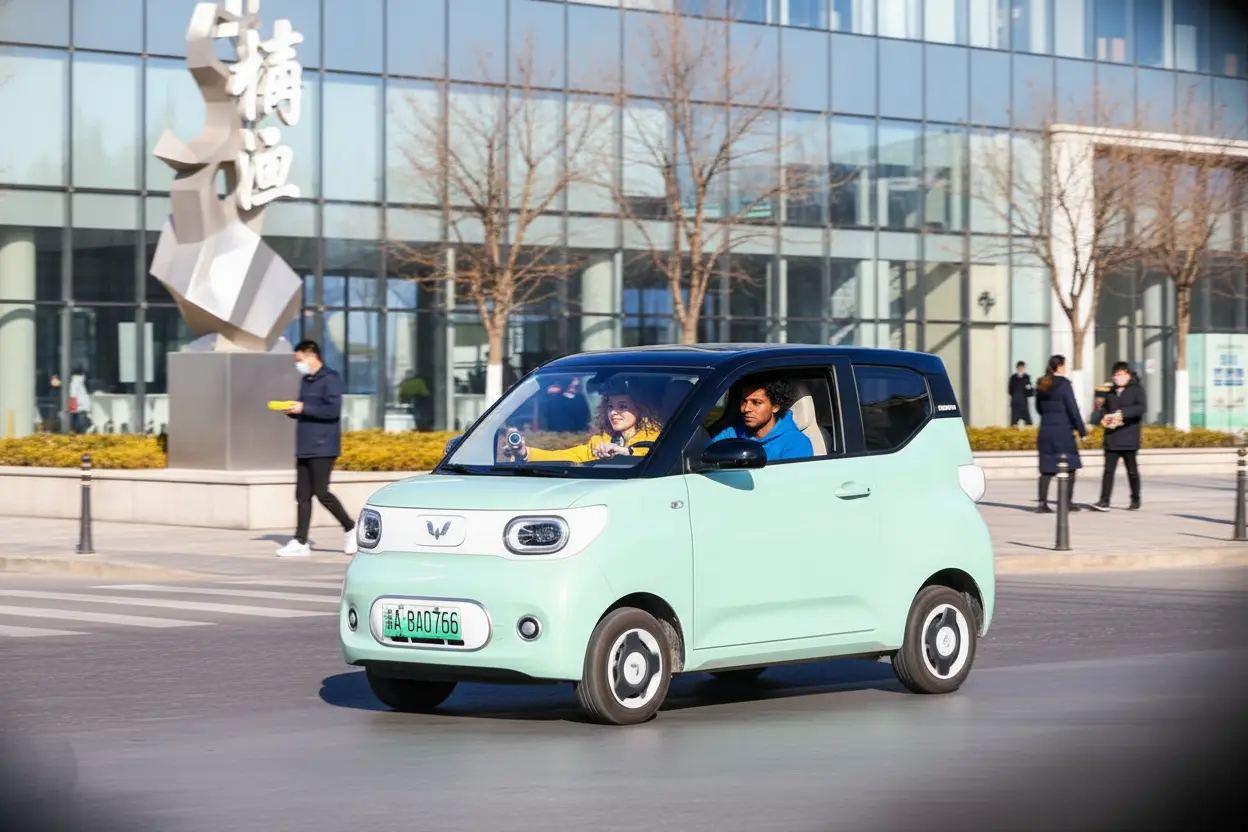
Imagine an electric car you can buy for less than the price of a fancy bicycle—and one that’s flying off showroom floors every two minutes. Welcome to the world of the Wuling Hongguang Mini EV, China’s pint-sized city car sensation. Is this minimalist marvel a preview of the affordable urban mobility to come?
The Price Barrier: Smashed and Scattered
For most drivers, going green comes with a hefty price tag. In Europe, dropping below the €20,000 mark for a new electric car is already considered wallet-friendly. But in China, the bar is set much lower (and that bar has been pole-vaulted over by the Wuling Hongguang Mini EV). With a starting price of just 35,800 yuan—roughly €4,300—the Mini EV delivers on the promise of low-cost electric mobility like few others can.
To put this in perspective, the Citroën Ami—a similarly-sized and styled micro-EV—costs at least €7,990 in Europe. Clearly, the mighty price gap explains why the Mini EV is a runaway hit with Chinese buyers searching for affordable, no-nonsense urban travel. Because when you can grab a car for half the price of an alternative, who wouldn’t be tempted?
China’s Two-Minute Bestseller
The numbers behind the Mini EV are nothing short of jaw-dropping. Since its 2020 launch, more than 1.7 million units have scooted onto Chinese streets. According to Car News China, there’s a new Mini EV owner roughly every two minutes. That astonishing rate has kept the Mini EV at the top of the country’s small EV sales charts for five consecutive years.
- In 2022 alone, 554,000 units found new homes.
- By 2024, the cumulative total since production kicked off had reached 1.4 million cars.
The trends don’t lie: demand remains rock-solid, and there’s no sign the success story will end anytime soon. In the world of sales, this car is the little engine that could—and does, relentlessly.
Formats, Flair, and a Dash of Fun
The Wuling Hongguang Mini EV comes in multiple flavors to suit a variety of urbanites. There’s a standard model, a five-door variant, and even a cabriolet for those who dream of sun-soaked city driving (or just want to look cool at the next stoplight). As if that weren’t enough, frequent special editions—sometimes in partnership with well-known brands or video games—keep things fresh and boost appeal among younger buyers. Who says practical can’t be playful?
But it’s not all about looks or quirky editions. The design is laser-focused on urban use. The Mini EV is just 3.26 meters long, 1.51 meters wide, and 1.58 meters tall, with a wheelbase of 2.19 meters. Despite its compact exterior, it manages to offer a surprisingly roomy experience for both driver and passengers. Proof that small packages can contain big surprises—kind of like urban mobility’s answer to a nesting doll.
Simplicity and Substance
Under its tiny hood, the Mini EV packs a 40-horsepower electric motor driving the rear axle. Its top speed? A city-friendly 100 km/h. Power comes from a lithium iron phosphate (LFP) battery with a 12.2 kWh capacity. On the Chinese test cycle, this translates to a tidy 205 km of range—or about 174 km using the more conservative European WLTP cycle.
- Fast charging from 30% to 80% takes roughly 35 minutes (with DC charging).
- Plug it into a normal outlet or AC charger, and a 20% to 100% top-up takes about 4.8 hours.
The Mini EV’s story began at the Chengdu Auto Show in 2020, and it’s barely slowed since. The car has racked up an impressive 1,986 patents—part of a broader surge in innovative patent filings among major Chinese automakers seeking to lock down their tech and designs. Details on all these patents haven’t been made public, but the figure alone signals an ongoing commitment to staying one step ahead in the EV game.
For now, there are no concrete plans to introduce the Mini EV to European soil. That stands out, considering its low purchase price, straightforward engineering, and compact form could make it a genuinely intriguing option for crowded city centers. European micro-EVs like the Citroën Ami, Fiat Topolino, and Dacia Spring already have a foothold—but whether the Mini EV will join them depends on demand, regulations, and (most crucially) adapting to European safety standards.
So, is the future of affordable city driving parked on the streets of China? If the Wuling Hongguang Mini EV is any clue, that future looks compact, clever, and strikingly attainable—provided you can get your hands on one before the next two minutes are up.

John is a curious mind who loves to write about diverse topics. Passionate about sharing his thoughts and perspectives, he enjoys sparking conversations and encouraging discovery. For him, every subject is an invitation to discuss and learn.